

Understanding Risk Aversion
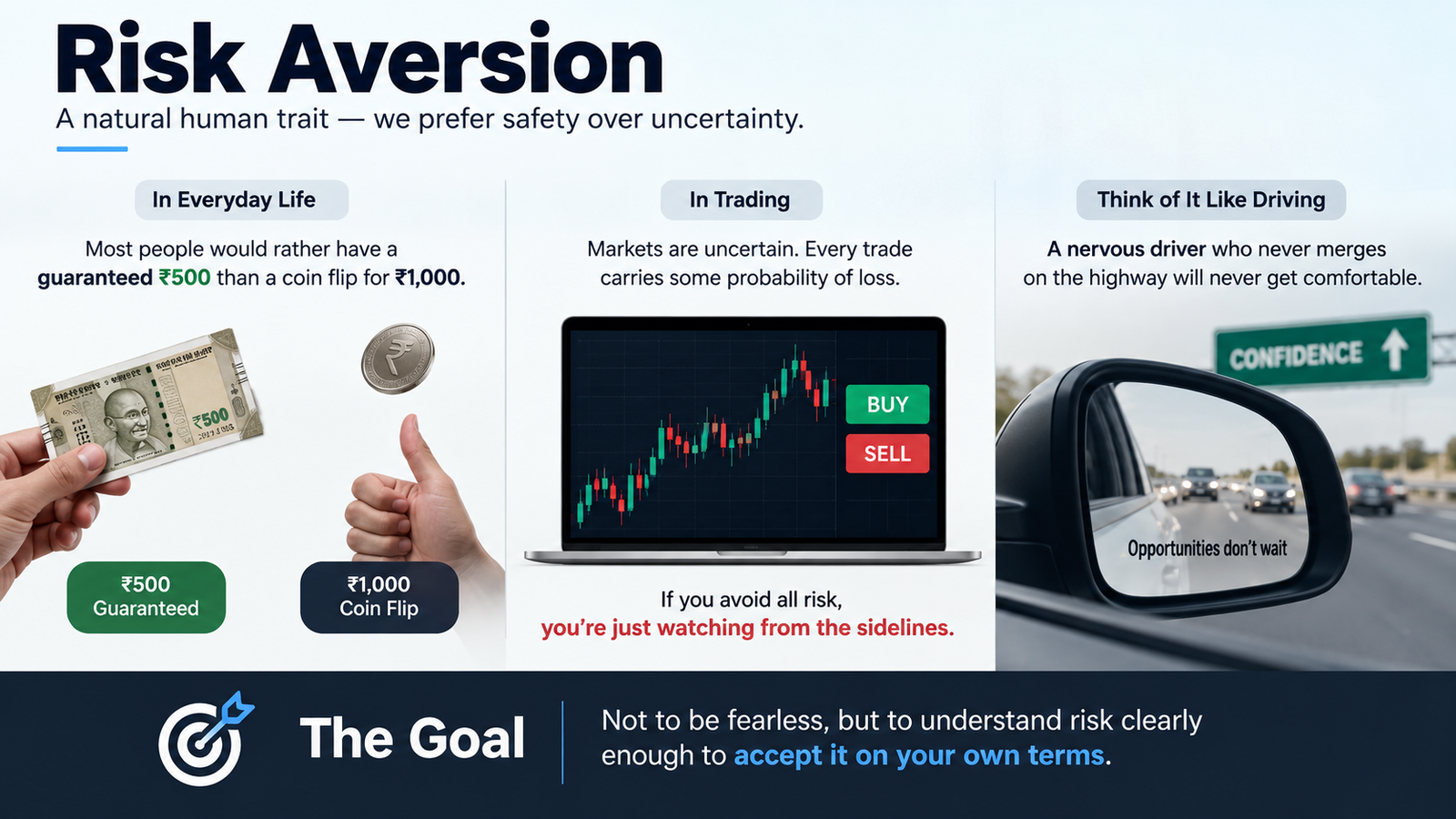
Risk aversion in trading is a natural human trait. It’s the reason most people would rather have a guaranteed ₹500 than a coin flip for ₹1,000. Our brains are wired to protect us from loss, and in everyday life, that instinct usually serves us well.
In trading, though, this same instinct can work against you. Markets are built on uncertainty, and every single trade carries some probability of loss. If your fear of that loss is strong enough to make you avoid taking any risk at all, you’re not really trading — you’re just watching from the sidelines.
Think of it like learning to drive. A nervous new driver who refuses to ever merge onto the highway will never get comfortable with traffic. Similarly, a trader who avoids every setup that involves risk will never develop the skill or instinct needed to trade well.
The goal isn’t to become fearless. It’s to understand risk clearly enough that you can accept it on your own terms.
The Psychology of Trading Risk
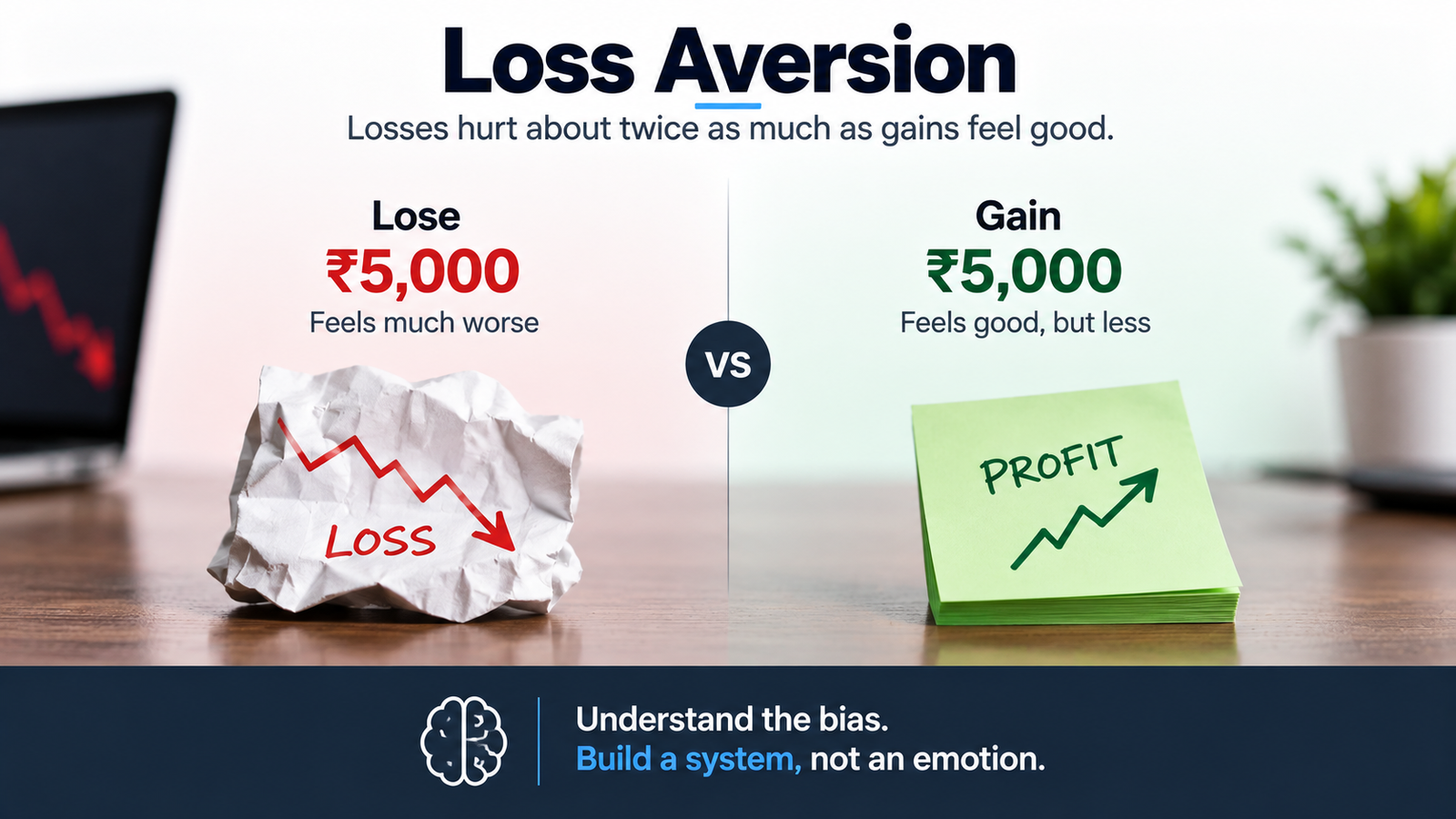
Behavioral finance researchers have spent decades studying why people make irrational financial decisions, and one consistent finding stands out: losses hurt roughly twice as much as equivalent gains feel good. This is called loss aversion, and it’s a close cousin of risk aversion.
That means losing ₹5,000 feels far worse than the joy of gaining ₹5,000. This asymmetry pushes traders to make defensive, sometimes irrational choices — like holding onto a losing trade far too long, hoping it will “come back,” while cutting winning trades short out of fear they’ll reverse.
Understanding this bias is the first step toward managing it. Once you know your brain is hardwired to overreact to loss, you can start building systems that override that instinct rather than obey it blindly.
Recognizing Fear-Based Decisions
Fear-based trading decisions often disguise themselves as “being careful.” But there’s a real difference between prudent risk management and decisions driven purely by anxiety.
Here are some common signs of fear-based trading:
- Closing a profitable trade the moment it dips slightly, even though your plan said to hold longer
- Refusing to enter a trade that meets all your criteria simply because the last trade lost money
- Constantly moving your stop-loss closer “just to be safe,” which often triggers an early exit
- Avoiding trading altogether after a losing streak, even when your strategy hasn’t actually changed
If any of these sound familiar, don’t be hard on yourself. Nearly every trader goes through this phase. Recognizing the pattern is what allows you to start correcting it.
Know Your Risk Tolerance
Before you can manage risk aversion, you need an honest picture of your actual risk tolerance — not the version you wish you had, but the real one.
Risk tolerance depends on several personal factors: your income stability, your financial goals, your trading experience, and even your temperament. Someone trading with money they can’t afford to lose will naturally feel more fear than someone trading with disposable capital.
A simple way to test this is to ask yourself: “If I lost this entire trade amount today, would it change my lifestyle?” If the honest answer is yes, your position size is probably too large for your comfort level, and that’s likely fueling your risk aversion.
Did You Know? SEBI’s investor education initiatives consistently emphasize that individuals should only trade or invest with capital they can afford to set aside, precisely because trading with essential funds amplifies emotional decision-making and fear-driven mistakes.
Risk vs. Reward
Every trade you take is essentially a bet on probability, not certainty. The idea of risk-reward ratio simply compares how much you’re willing to lose against how much you stand to gain.
For example, if you risk ₹1,000 to potentially make ₹3,000, that’s a 1:3 risk-reward ratio. Even if you’re wrong more often than you’re right, a favorable ratio can still make you profitable over time.
This is where many risk-averse traders get stuck. They focus so heavily on avoiding the ₹1,000 loss that they miss the bigger picture — the potential ₹3,000 gain that makes the trade worthwhile in the first place.
| Risk-Reward Ratio | Win Rate Needed to Break Even |
| 1:1 | 50% |
| 1:2 | 34% |
| 1:3 | 25% |
| 1:4 | 20% |
As the table shows, a favorable risk-reward ratio means you don’t need to be right most of the time to stay profitable. This math alone can ease a lot of unnecessary fear.
Setting Risk Limits
One of the most practical ways to manage fear is to decide, in advance, exactly how much you’re willing to risk — before emotions get involved.
A commonly used guideline among experienced traders is to risk no more than 1–2% of your total trading capital on any single trade. This way, even a string of losses won’t wipe out your account or your confidence.
Setting these limits ahead of time removes the guesswork in the heat of the moment. You’re not deciding how much to risk while your heart is racing; you already decided calmly, days or weeks earlier.
Position Sizing Strategies
Position sizing is simply the process of deciding how many shares, lots, or contracts to buy based on your risk tolerance and stop-loss level. It’s one of the most underrated skills in trading, and mastering it does wonders for reducing anxiety.
Here’s a simple formula traders often use:
Position Size = (Account Risk Amount) ÷ (Entry Price − Stop-Loss Price)
Let’s say you have a ₹1,00,000 account and you’re comfortable risking 1% (₹1,000) per trade. If your entry price is ₹100 and your stop-loss is ₹95, your risk per share is ₹5. That means you could buy 200 shares (₹1,000 ÷ ₹5) while staying within your risk limit.
This kind of structured approach takes the emotion out of “how much should I buy?” and replaces it with a clear, repeatable calculation.
Using Stop-Loss Effectively
A stop-loss order is your safety net — it automatically exits your trade once the price hits a predetermined level, capping your potential loss. Yet many risk-averse traders either skip stop-losses entirely out of fear of “getting stopped out too soon,” or place them so tight that normal market fluctuations trigger constant, unnecessary exits.
The trick is finding a stop-loss level based on the market’s actual behavior, not your emotional comfort. Look at recent price swings or support and reversal zones rather than an arbitrary percentage that feels safe.
A well-placed stop-loss actually reduces anxiety over time because it removes the need to babysit every trade. You know your worst-case scenario upfront, so there’s less to fear.
Managing Market Volatility
Volatility is often mistaken for danger, but it’s really just a measure of how much prices move over a given period. Higher volatility means bigger price swings in both directions — which can mean bigger gains, not just bigger losses.
During volatile periods, risk-averse traders often freeze completely or drastically reduce their position sizes out of panic rather than strategy. A more balanced approach is to adjust your position size proportionally to volatility, rather than avoiding the market altogether.
For instance, during high-volatility phases like earnings season or major economic announcements from the RBI, some traders deliberately reduce position sizes rather than avoid trading entirely. This keeps them engaged with the market while managing exposure sensibly.
Avoiding Emotional Trading
Emotional trading happens when decisions are driven by feelings — fear, excitement, revenge, or overconfidence — rather than by your predetermined strategy.
A classic example: a trader loses money on a trade, feels frustrated, and immediately jumps into another trade to “win it back.” This revenge trading almost always leads to bigger losses because the decision wasn’t based on analysis at all.
The antidote is simple to state but hard to practice: pause before you act. A short break — even five minutes away from the screen — can be the difference between a calculated decision and an emotional reaction.
Building Trading Confidence
Confidence in trading isn’t built through motivation or willpower. It’s built through repetition, small wins, and proof that your process actually works.
Start small. Trade with position sizes so small that a loss barely registers emotionally. As you accumulate a track record of following your plan — win or lose — your confidence will grow naturally, because it’s based on evidence rather than hope.
Many professional traders also use a practice account or paper trading to rebuild confidence after a rough patch, since it allows them to test strategies without financial consequences while still experiencing real market conditions.
Creating a Trading Plan
A trading plan is your rulebook — it spells out your entry criteria, exit criteria, position sizing, and risk limits before you ever place a trade. Without one, every decision becomes a fresh emotional negotiation with yourself.
A good trading plan typically includes:
- The specific setups or patterns you’ll trade
- Your maximum risk per trade and per day
- Clear entry and exit rules
- Conditions under which you’ll stop trading for the day
Having this plan written down — not just in your head — makes it much harder for fear or excitement to your decisions in the moment.
Handling Losing Trades
Losses are not failures; they’re the cost of doing business as a trader. Even the most skilled traders lose on a meaningful percentage of their trades — what separates them from beginners is how they respond afterward.
Here’s a real-world scenario: imagine two traders both lose ₹2,000 on a trade. Trader A accepts the loss, reviews what happened, and moves on to the next setup calmly. Trader B spirals, doubts their entire strategy, and either stops trading or overcompensates with a riskier trade. Trader A is building a sustainable trading career; Trader B is building a pattern of emotional decision-making.
Reframing losses as “tuition” rather than failure can dramatically reduce the emotional weight they carry.
Avoiding Over trading
Interestingly, risk aversion and overtrading often exist in the same trader at different times. After a cautious streak, some traders overcorrect by taking too many trades, trying to make up for lost time or missed opportunities.
Overtrading typically shows up as trading outside your plan, entering trades out of boredom, or increasing frequency after a loss to “get even.” It usually leads to higher transaction costs and lower quality decisions, since not every trade meets your actual criteria.
A simple guardrail is setting a maximum number of trades per day or week. Once you hit that limit, you step away — no exceptions, no matter how tempting the next setup looks.
Maintaining a Risk Journal
A risk journal is different from a general trading journal — it specifically tracks how much you risked, why you chose that amount, and how you felt during the trade.
Over weeks and months, patterns emerge. You might notice you consistently risk less after a losing streak, or that your risk-taking spikes after a big win. These patterns are invaluable because you can’t fix what you don’t measure.
Try logging just three things after every trade: the amount risked, your emotional state (calm, anxious, excited), and whether you followed your plan. This small habit builds enormous self-awareness over time.
Adapting to Market Conditions
Markets shift between trending, ranging, and volatile phases, and a strategy that works beautifully in one condition can fail miserably in another. Risk-averse traders sometimes freeze during these shifts, unsure whether to adjust their approach or avoid trading altogether.
The healthier response is to build flexibility into your plan from the start. This might mean using smaller position sizes during choppy, unpredictable markets and slightly larger ones when conditions are clearer and more favorable to your strategy.
Staying informed through reliable sources — such as RBI policy updates or SEBI circulars affecting market structure — also helps you anticipate shifts rather than being caught off guard by them.
Capital Preservation
Capital preservation simply means protecting your trading funds so you can stay in the game long enough to succeed. It’s often said among experienced traders that the first rule of trading is “don’t lose money,” and the second rule is “don’t forget rule number one.”
This doesn’t mean avoiding all risk — it means avoiding unnecessary or oversized risk that could knock you out of trading altogether. A trader who loses 50% of their capital needs a 100% gain just to break even, which illustrates how devastating large losses really are.
Prioritizing capital preservation over chasing quick profits is one of the most mature shifts a trader can make.
Developing a Disciplined Mindset
Discipline is what bridges the gap between knowing what to do and actually doing it under pressure. It’s easy to say “I’ll follow my stop-loss” when you’re calmly reading an article; it’s much harder when your money is on the line and the price is moving against you.
Building discipline is less about dramatic willpower and more about small, consistent habits — sticking to your position sizing rules every single time, reviewing your trades honestly, and refusing to make exceptions “just this once.”
Over time, disciplined behavior becomes automatic, the same way an experienced driver doesn’t consciously think about checking mirrors before changing lanes.
Practical Risk Management Framework
Bringing everything together, here’s a simple framework you can apply immediately:
- Define your risk tolerance honestly, based on your finances and temperament
- Set a maximum risk percentage per trade (commonly 1–2%)
- Calculate position size using your stop-loss distance
- Write a trading plan with clear entry, exit, and risk rules
- Track every trade in a risk journal
- Review your journal weekly to identify emotional patterns
- Adjust position sizing based on market volatility
- Set daily or weekly trade limits to avoid overtrading
This isn’t a one-time exercise — it’s a cycle you repeat and refine as you grow as a trader.
Pros and Cons of Being Risk-Averse in Trading
| Pros | Cons |
| Protects capital from large, avoidable losses | Can cause you to miss legitimate opportunities |
| Encourages careful analysis before entering trades | May lead to exiting winning trades too early |
| Reduces likelihood of reckless, emotional decisions | Can create decision paralysis during good setups |
| Builds a habit of using stop-losses and limits | Excessive caution can stunt learning and growth |
Myth vs. Fact
| Myth | Fact |
| “Successful traders never feel fear.” | Even experienced traders feel fear; they’ve just learned to act despite it. |
| “Avoiding all risk keeps your money safe.” | Excessive risk avoidance often means missing genuine opportunities, which has its own cost. |
| “A bigger position size means bigger profits.” | Oversized positions increase both potential losses and emotional stress, often leading to worse decisions. |
| “You need to win most of your trades to profit.” | A favorable risk-reward ratio can make you profitable even with a win rate below 50%. |
Beginner Checklist: Overcoming Risk Aversion
- Define exactly how much capital you can afford to trade with
- Set a maximum risk percentage per trade (1–2% is a common starting point)
- Write down a simple trading plan before your next trade
- Practice position sizing calculations until they feel automatic
- Use a stop-loss on every single trade, without exceptions
- Start a risk journal and log every trade honestly
- Review your trades weekly, focusing on emotions as much as outcomes
- Consider paper trading if fear is currently overwhelming your decisions
Key Takeaways
- Risk aversion is natural, but unmanaged fear can quietly limit your growth as a trader
- Understanding risk-reward ratios shows that you don’t need to win every trade to be profitable
- Position sizing and stop-losses turn vague fear into a calculated, manageable number
- A written trading plan removes emotional guesswork from your decisions
- Capital preservation matters more than chasing quick, oversized gains
- Confidence comes from consistent, disciplined practice — not motivation alone
Final Thoughts
Overcoming risk aversion isn’t about flipping a switch and suddenly becoming fearless. It’s a gradual process built on self-awareness, structure, and small, repeated proof that your strategy and discipline actually work.
Start small, track everything, and be patient with yourself. The traders who last aren’t the ones who eliminated fear entirely — they’re the ones who built systems solid enough to trade well alongside it.
Risk aversion in trading refers to a tendency to avoid taking on market risk, even when a trade’s probability and potential reward may justify it. It’s usually driven by fear of loss rather than objective analysis.
Not entirely. A healthy degree of caution helps protect capital, but excessive risk aversion can cause missed opportunities, early exits from winning trades, and decision paralysis.
Many experienced traders limit risk to about 1–2% of total trading capital per trade, though the right amount depends on individual financial circumstances and risk tolerance.
Position sizing turns a vague sense of risk into a specific, calculated number, which removes emotional guesswork and helps traders stick to their plan with more confidence.
Yes. A risk journal helps traders spot emotional patterns, such as under-risking after losses or over-risking after wins, making it easier to correct these tendencies over time.