

What Are Corporate Bonds?
A corporate bond is a loan you give to a company. In return, the company promises to pay you interest at regular intervals and return your original money on a fixed date.
You become a lender, not an owner. That is the key difference from buying shares. A shareholder owns a slice of the business and shares in its profits and losses. A bondholder is simply owed money.
In India, you will often see these instruments called debentures or non-convertible debentures (NCDs). The names differ slightly, but the idea is the same.
Quick Summary: A corporate bond is an IOU from a company. You lend money, the company pays interest, and it returns your principal at maturity.
How Do Corporate Bonds Work?
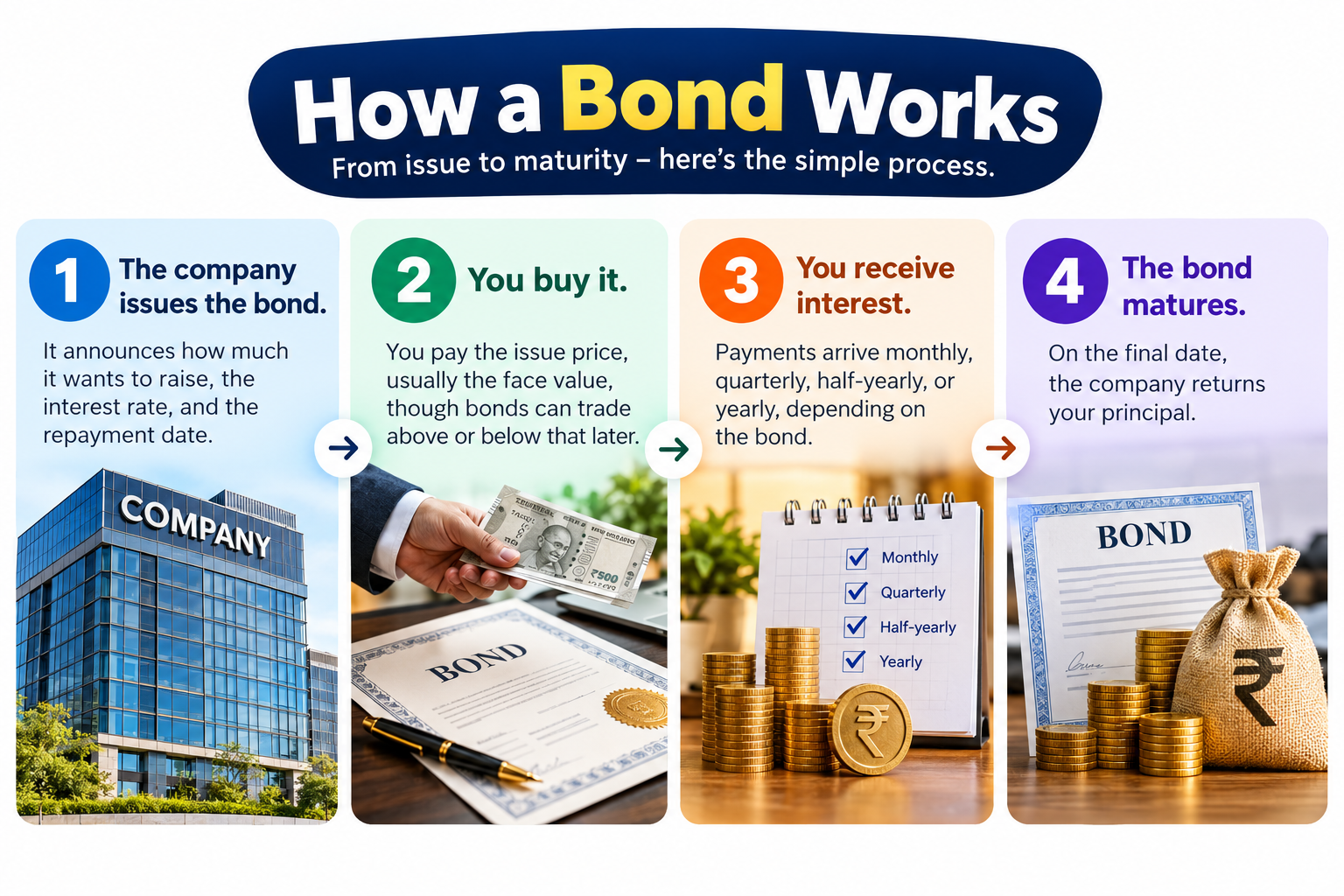
- The company issues the bond. It announces how much it wants to raise, the interest rate, and the repayment date.
- You buy it. You pay the issue price, usually the face value, though bonds can trade above or below that later.
- You receive interest. Payments arrive monthly, quarterly, half-yearly, or yearly, depending on the bond.
- The bond matures. On the final date, the company returns your principal.
Some bonds pay all the interest at maturity instead. These are called cumulative bonds, and they suit people who don’t need regular income.
Between issue and maturity, many bonds trade on exchanges or through registered platforms. That means you can sometimes sell before maturity, though the price you get may differ from what you paid.
Why Do Companies Issue Corporate Bonds?
Companies need money to build factories, repay older debt, buy equipment, or expand into new markets. They have three main ways to raise it: bank loans, selling shares, or issuing bonds.
Bonds appeal to companies for a few reasons.
- Flexibility. A company can design the tenure, interest rate, and payout schedule to match its cash flow.
- No loss of ownership. Issuing bonds does not dilute existing shareholders the way issuing new shares does.
- Potentially lower cost. A financially strong company may borrow from the market at a better rate than a bank would offer.
- Tax treatment. Interest paid on borrowings is generally a deductible business expense.
For you, the investor, this matters because a company’s reason for borrowing tells you something about its health. A firm borrowing to expand a profitable business looks different from one borrowing to pay off earlier loans it cannot manage.
How Do Investors Make Money From Corporate Bonds?
There are two ways to earn from a bond. One is steady and predictable. The other depends on market movements.
Interest Payments
This is the main attraction. The company pays you a fixed percentage of the bond’s face value, called the coupon.
Suppose you buy a ₹10,000 bond with a 9% coupon. You would receive ₹900 a year in interest, as long as the company keeps its promise. The word “promise” matters, and we will return to it in the risks section.
Capital Gains
Bond prices move after issue. If you buy at ₹9,600 and later sell at ₹10,200, the ₹600 difference is a capital gain.
Prices rise and fall mainly because of changes in interest rates and in the company’s perceived creditworthiness. If you hold until maturity and the company pays up, you get the face value back regardless of the price swings in between.
Note that tax rules for interest and capital gains on bonds have changed several times in recent years. Check the current Income Tax Department guidelines, or speak to a qualified tax professional, before you invest.
Types of Corporate Bonds
Not all bonds carry the same level of safety or reward. Here are the main categories you will come across.
Investment-Grade Bonds
These come from companies with strong finances and high credit ratings, generally BBB- or above on the Indian rating scale. The chance of default is considered lower, so the interest rates are usually lower too.
Large, established companies tend to issue these. They suit people who value stability over higher returns.
High-Yield Bonds
Companies with weaker ratings must offer higher interest to attract lenders. These are called high-yield, or sometimes “junk,” bonds.
The extra interest is payment for extra risk. A higher coupon should always make you ask: why does this company have to pay so much to borrow?
Secured and Unsecured Bonds
A secured bond is backed by specific company assets, such as property or machinery. If the company cannot pay, bondholders have a claim on those assets, with a debenture trustee acting on their behalf.
An unsecured bond has no such backing. You rely entirely on the company’s ability to repay. Because of the added risk, unsecured bonds typically offer higher interest.
Convertible Bonds
These let you convert the bond into company shares under pre-agreed terms. They offer a mix of fixed income and potential equity upside.
The trade-off is usually a lower coupon, since you are being given the conversion option. Convertible bonds are more complex, so beginners should read the terms carefully or skip them at first.
Key Features of Corporate Bonds
Four terms appear on almost every bond document. Learn these and you can read most bond offerings with confidence.
Face Value
Face value, or par value, is the amount the company repays at maturity. It is also the base on which interest is calculated.
In India, public issues of NCDs commonly carry a face value of ₹1,000. SEBI has also lowered the face value for certain privately placed debt securities to make them more accessible, so check the latest SEBI circulars for current limits.
Coupon Rate
The coupon rate is the annual interest percentage paid on face value. A 9% coupon on a ₹1,000 bond means ₹90 per year.
The coupon is typically fixed when the bond is issued. It does not change if market rates move later.
Maturity Date
This is the date the company must return your principal. Corporate bonds can run from under a year to ten years or more.
Longer bonds usually offer higher interest but lock up your money longer. They are also more sensitive to interest rate changes.
Credit Rating
A credit rating is an independent opinion on how likely the issuer is to repay. In India, SEBI-registered credit rating agencies such as CRISIL, ICRA, CARE Ratings, India Ratings, and Acuité publish these.
Ratings run from AAA (highest safety) down to D (default). Think of it like a school report card for a company’s borrowing reliability. It is a useful guide, but ratings can change, and they are not guarantees.
What Is Bond Yield?
Beginners often mix up coupon and yield, so let’s separate them.
The coupon is fixed. The yield is what you actually earn based on the price you paid.
Say a bond has a ₹10,000 face value and a 9% coupon (₹900 a year). If you buy it at ₹9,600, your current yield is ₹900 ÷ ₹9,600, which is about 9.4%. If you pay ₹10,400, the yield drops to about 8.7%.
You will also hear about yield to maturity (YTM). It estimates your total annual return if you hold the bond until maturity, counting both interest and any gain or loss between your purchase price and the face value. YTM is the most useful number for comparing different bonds, because it puts them on equal footing.
Did You Know? Bond prices and yields move in opposite directions. When a bond’s price falls, its yield rises, and vice versa. It’s like a seesaw: one side can’t go up without the other going down.
Corporate Bonds vs. Fixed Deposits
Many Indian investors start with bank fixed deposits (FDs), so this comparison comes up often.
An FD is a deposit with a bank. A bond is a loan to a company. That difference changes the safety picture.
Bank deposits in India are insured by the Deposit Insurance and Credit Guarantee Corporation (DICGC) up to ₹5 lakh per depositor per bank, as per RBI information. Corporate bonds carry no such insurance. If a company fails, you could lose some or all of your money.
| Feature | Corporate Bonds | Bank Fixed Deposits | Government Bonds |
| Who borrows | Company | Bank | Government |
| Typical returns | Often higher than FDs | Moderate | Generally lower than corporate bonds |
| Safety | Depends on issuer and rating | Insured up to ₹5 lakh (DICGC) | Sovereign backing |
| Liquidity | Varies; can be low | Premature withdrawal usually allowed with penalty | Generally good for G-Secs |
| Can sell before maturity? | Yes, through exchanges or platforms | No, only premature closure | Yes |
| Price changes | Yes | No | Yes |
| Best suited for | Investors who accept credit risk | Safety-first savers | Very low-risk investors |
If you want certainty above all, FDs are simpler. If you are willing to accept more risk for potentially higher income, bonds are worth studying.
Corporate Bonds vs. Government Bonds
Government securities, or G-Secs, are issued by the central or state governments. They are considered to carry very low default risk because the government can raise money through taxes and, in the case of the Centre, through its currency.
Corporate bonds carry the risk that a company hits trouble. To compensate, they usually pay more than a government bond of similar maturity. That extra interest is called the credit spread.
A simple way to think about it: a government bond is like lending to the most reliable borrower in the country, while a corporate bond is like lending to a respected but human business that can have a bad year.
The RBI publishes information on G-Sec auctions and yields, which makes a handy benchmark when you assess whether a corporate bond’s extra interest is worth the extra risk.
What Are the Risks of Corporate Bonds?
Every investment has risks. Bonds just show theirs in quieter ways. Let’s go through the four main ones.
Credit/Default Risk
This is the chance the company fails to pay interest or principal. A downgrade in credit rating can also drop the bond’s market price even before any default happens.
India’s debt markets have seen well-known defaults in the past, which reminded investors that even highly rated names are not immune. Spreading money across issuers helps limit the damage if one fails.
Interest Rate Risk
When market interest rates rise, newer bonds offer better coupons, so older bonds with lower coupons become less attractive. Their prices fall.
If you hold to maturity, this matters less. If you need to sell early, you might get less than you paid.
Liquidity Risk
Some bonds trade rarely. If you need cash urgently, you may struggle to find a buyer, or you may have to accept a lower price.
Large, well-known issuers tend to be easier to trade. Smaller or lower-rated issues can be hard to sell.
Reinvestment Risk
When your bond pays interest or matures, you must put that money to work again. If rates have dropped, you may only find lower returns.
Planning your cash flow in advance helps. Some investors build a “ladder” of bonds maturing in different years so they are never forced to reinvest everything at once.
How to Evaluate a Corporate Bond Before Investing
You don’t need a finance degree to run a decent check. Work through these questions in order.
- Check the credit rating. Read the rating rationale published by the agency, not just the letter grade. It explains the strengths and concerns.
- Look at the company’s finances. Is revenue stable? Does it earn enough to cover interest payments? Annual reports and stock exchange filings are free.
- Understand the security. Is the bond secured? What assets back it? Who is the debenture trustee?
- Compare the yield. Place it next to FD rates, government bond yields, and bonds from similar-rated companies. An unusually high yield deserves extra suspicion.
- Read the offer document. The key risks and terms are all in there, including call options that let the company repay early.
- Check the tenure. Make sure the maturity fits when you will need the money.
- Confirm the platform is registered. SEBI maintains lists of registered intermediaries, including online bond platform providers.
A real-world habit worth building: if you can’t explain in two sentences why a company needs the money and how it will repay, you probably need to read more.
Who Should Consider Corporate Bonds?
Corporate bonds can suit certain people, though they are not for everyone.
- Income seekers, such as retirees who want regular interest, provided they understand the credit risk.
- Investors diversifying beyond equity and FDs, who want a different return pattern in their portfolio.
- Savers with a fixed time horizon, for example someone who needs a lump sum in three years.
- Investors comfortable reading ratings and company information, or willing to learn.
They may not suit you if you cannot afford to lose any of your capital, if you may need the money on short notice, or if you do not want to monitor an issuer. In those cases, simpler options may be a better starting point.
This article is educational. For a recommendation fitted to your circumstances, a SEBI-registered investment adviser can help.
Advantages and Disadvantages of Corporate Bonds
| Advantages | Disadvantages |
| Regular, predictable income through coupons | No deposit insurance; default can cause losses |
| Often higher interest than FDs or government bonds | Returns depend on the issuer’s ability to pay |
| Wide range of tenures and issuers | Prices move with interest rates and credit news |
| Can diversify a portfolio | Some bonds are hard to sell quickly |
| Secured options offer some asset backing | Complex terms (call options, subordination) can confuse beginners |
| Principal returned at maturity if issuer pays | Interest is taxable; rules can change |
How to Invest in Corporate Bonds in India
You have several routes, and each has its own convenience and cost.
1. Public issues of NCDs.Companies sometimes open NCD issues to the public. You apply through your bank, broker, or the exchange platform, much like an IPO.
2. Secondary market on stock exchanges. Listed bonds trade on the debt segments of the exchanges. You need a demat and trading account.
3. Online Bond Platform Providers (OBPPs). SEBI introduced a framework for these platforms, and they must be registered. They let you browse and buy bonds online, often with smaller minimum amounts.
4. Debt mutual funds. If picking individual bonds feels like too much, funds managed by professionals invest in a basket of bonds. AMFI publishes data and investor education on mutual funds. Funds carry their own risks, including credit and interest rate risk, so read the scheme documents.
Practical steps for a first purchase:
- Open and verify a demat account.
- Complete your KYC.
- Confirm the platform or broker is SEBI-registered.
- Start with a small amount while you learn.
- Keep records of the offer document and your transaction.
A Simple Example of How Corporate Bonds Work
Let’s follow a made-up company, Greenfield Foods Ltd., which wants to build a new packaging unit.
Greenfield issues bonds with a ₹10,000 face value, a 9% annual coupon, and a three-year maturity. It carries an AA rating.
Meera, a teacher, buys one bond at face value. Her year-by-year cash flow looks like this:
| Year | What Meera Receives |
| Year 1 | ₹900 interest |
| Year 2 | ₹900 interest |
| Year 3 | ₹900 interest + ₹10,000 principal |
Her total inflow is ₹12,700 on a ₹10,000 investment, assuming Greenfield pays as promised.
Now imagine that after a year, market interest rates rise, and similar new bonds offer 10%. If Meera needed to sell, buyers would likely pay less than ₹10,000 for her 9% bond. If she holds on until maturity, that dip does not change her promised payments.
But suppose Greenfield’s business hits trouble and its rating is cut. The price could fall further, and in the worst case, payments could be delayed or missed. This is why Meera chose a rated, transparent company, and why she kept this bond to a modest share of her savings.
(This is a made-up example to show the mechanics, not a prediction or recommendation.)
Myth vs. Fact
| Myth | Fact |
| Bonds are as safe as fixed deposits. | Bank FDs have DICGC insurance up to ₹5 lakh; corporate bonds do not. |
| A high rating means zero risk. | Ratings are opinions and can be downgraded. |
| You must hold a bond until maturity. | Many bonds can be sold before maturity, though the price may vary. |
| A higher coupon always means a better bond. | A high coupon often signals higher risk. |
| Only large investors can buy bonds. | Lower face values and online platforms have made them more accessible. |
Beginner Checklist
Before buying your first corporate bond, tick these off:
- I know why I’m investing and when I’ll need the money.
- I’ve checked the credit rating and read the rating rationale.
- I understand whether the bond is secured or unsecured.
- I’ve compared the yield with FDs and government bonds.
- I’ve read the offer document, including the risk factors.
- The platform or broker is SEBI-registered.
- I’m not putting all my money in one issuer.
- I understand the tax treatment, or I’ve asked a professional.
- I’ve kept an emergency fund separate from this investment.
Key Takeaways
- A corporate bond is a loan you give to a company in exchange for interest and the return of your principal.
- Your income comes from coupons and, sometimes, price gains.
- Credit ratings, security, and yield help you judge the risk and reward.
- Unlike bank FDs, corporate bonds carry default risk and no deposit insurance.
- Interest rates, liquidity, and reinvestment all affect your real outcome.
- Start small, diversify, and use SEBI-registered channels.
Final Thoughts: Are Corporate Bonds Right for You?
Corporate bonds are neither a secret shortcut nor a trap. They are a tool, and like any tool, they work well when you understand what they do.
If you value regular income, can accept some credit risk, and are willing to read a rating report and an offer document, bonds can add useful balance to your savings. If you need absolute certainty or fast access to cash, simpler options may serve you better.
Start with a small amount. Choose rated, transparent issuers. Spread your money around. And whenever a return looks unusually generous, ask what risk is hiding behind it.
A corporate bond is a loan you give to a company. The company pays you interest regularly and returns your original amount on a set maturity date.
Safety depends on the issuer. Highly rated companies carry lower default risk, but no corporate bond is risk-free, and unlike bank deposits, bonds are not covered by deposit insurance.
Most pay a fixed coupon at set intervals, such as monthly, quarterly, half-yearly, or annually. Some cumulative bonds pay all interest at maturity.
Yes. You could lose money if the company defaults, or if you sell before maturity at a price lower than you paid.
In common usage in India, the terms are often used interchangeably. A debenture is typically backed by the issuer’s general creditworthiness, while a bond may be secured by specific assets, though the labels vary by issue.
Disclaimer: This article is for educational purposes only and is not investment, tax, or legal advice. Investments in securities are subject to market risks. Returns are not guaranteed. Please read all offer documents carefully and consult a SEBI-registered investment adviser before investing.