

Introduction
On 14 October 2026, the Securities and Exchange Board of India (SEBI) published a consultation paper that proposes a major rethink of how small and medium enterprises raise money through IPOs. The regulator is asking the public for comments until 4 November 2026.
If you are a first-time investor, a business owner thinking about going public, or just someone who keeps hearing about “SME IPOs” on the news, this guide is for you. We will walk through what is being proposed, why it matters, and what you can sensibly do with the information.
One thing before we start. These are proposals. Nothing has changed yet, and the final rules may look different after SEBI reviews the feedback.
Overview of SEBI’s Proposed SME IPO Rule Changes
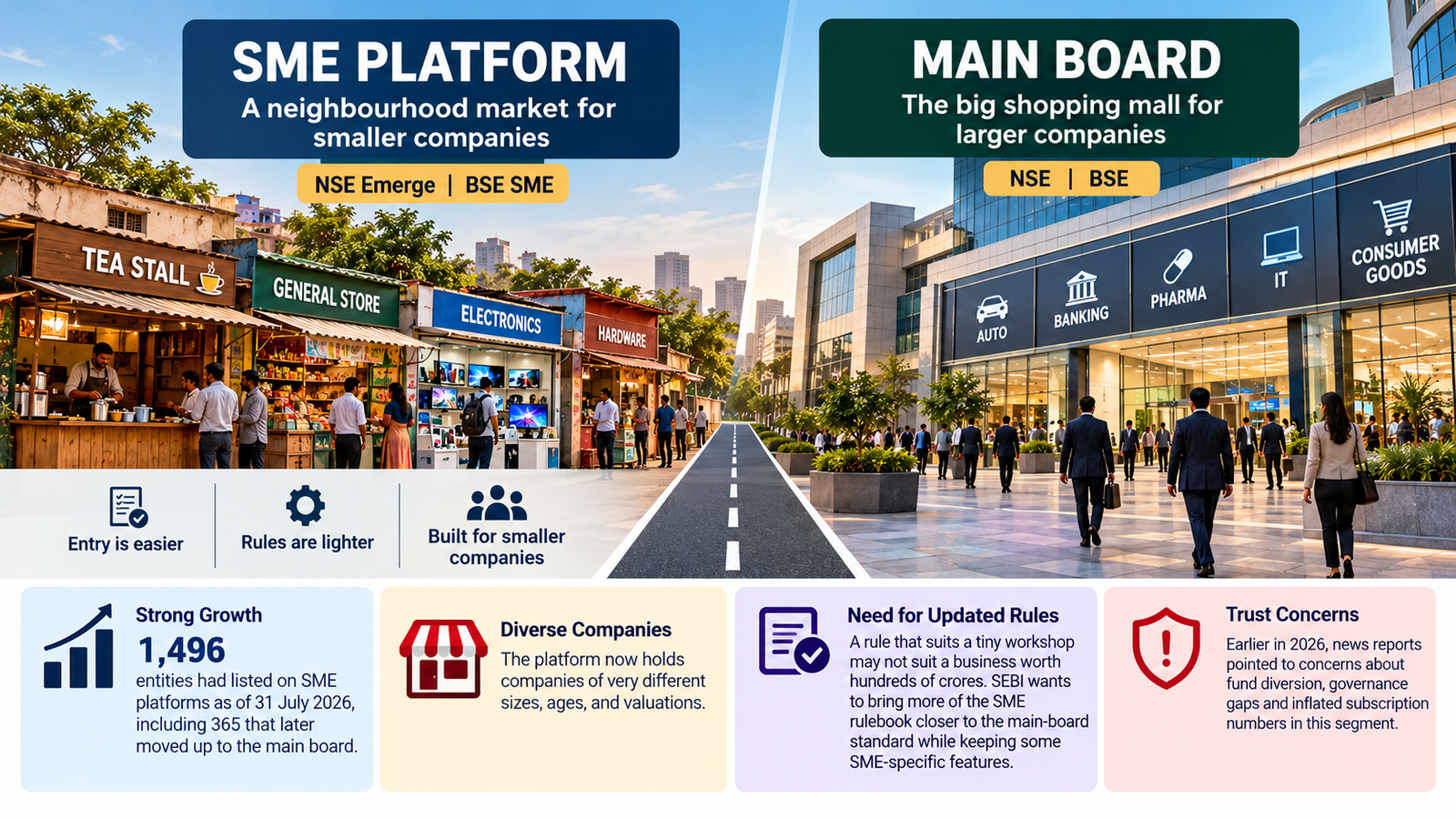
Let’s begin with the basics. An SME platform is a separate section of a stock exchange, such as NSE Emerge or BSE SME, built for smaller companies. Think of it as a neighbourhood market, while the main board is the big shopping mall. Entry is easier, but the rules and safety nets are lighter too.
The segment has grown fast. According to the consultation paper coverage, 1,496 entities had listed on SME platforms as of 31 July 2026, including 365 that later moved up to the main board. That is a lot of companies for a platform that began in 2012.
SEBI’s argument is simple. The platform now holds companies of very different sizes, ages, and valuations. A rule that suits a tiny workshop may not suit a business worth hundreds of crores. So the regulator wants to bring more of the SME rulebook closer to the main-board standard while still keeping some SME-specific features.
There is also a trust angle. Earlier in 2026, news reports pointed to concerns about fund diversion, governance gaps and inflated subscription numbers in this segment. Those worries sit in the background of the current proposals.
What a consultation paper means. SEBI publishes one when it wants public feedback before making a rule. Investors, lawyers, bankers, exchanges, and companies can all send comments. After that, SEBI’s board decides what to approve, tweak, or drop.
What happens next. If the proposals are approved, they would take effect after a three-month transition period. Until then, the current SME IPO regulations stay in force. One news report gave a simple example: if rules were notified on 31 December 2026, they would apply from 1 April 2027.
Key Proposed Changes to SME IPO Regulations
The paper covers many points. Here are the main ones, in plain English.
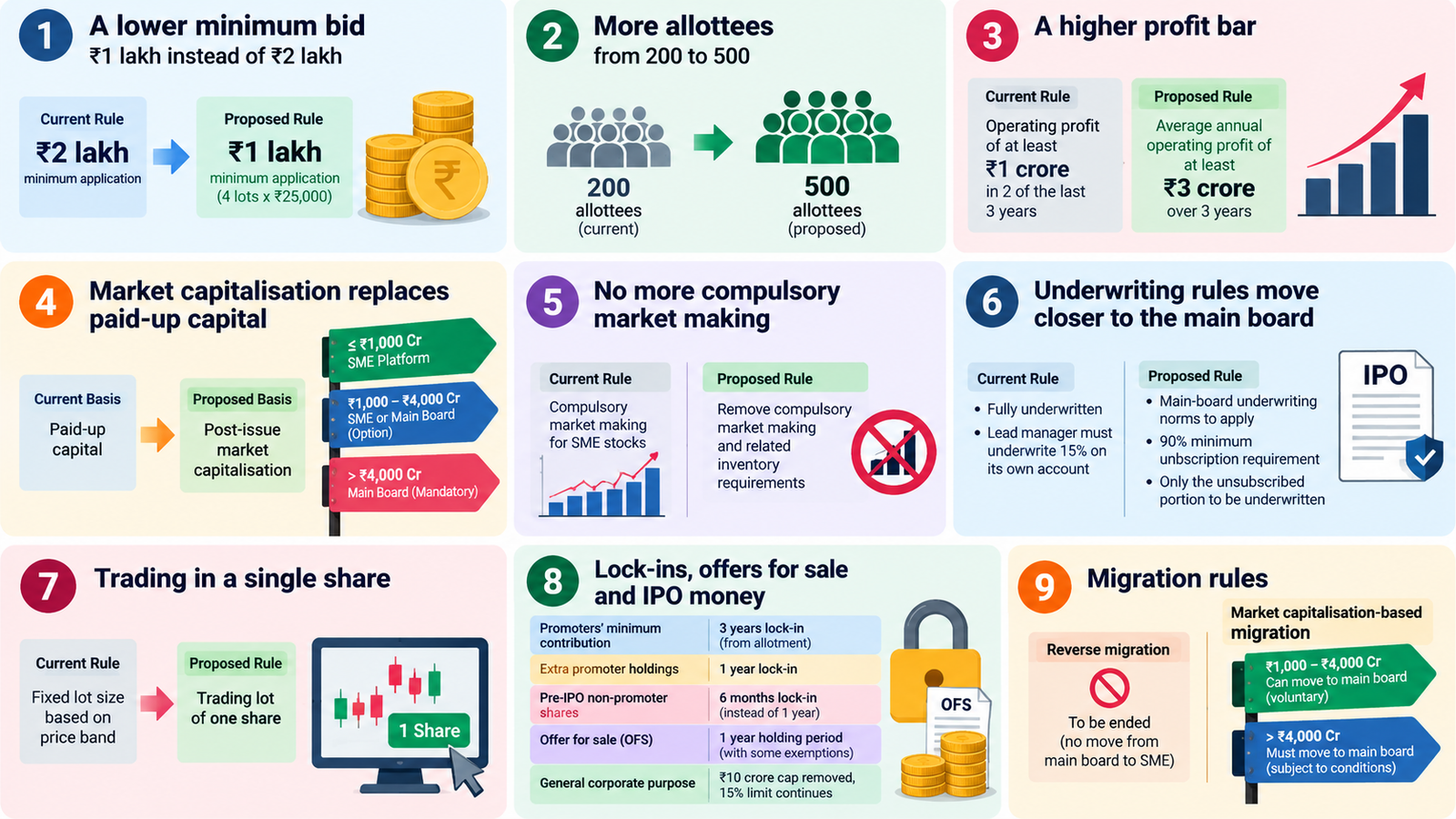
1. A lower minimum bid: ₹1 lakh instead of ₹2 lakh
Today, an investor has to bid at least ₹2 lakh in an SME IPO. SEBI now proposes a minimum of four lots, with each lot worth at least ₹25,000. That brings the minimum application to ₹1 lakh.
Think of it like a gym membership that once required a two-year plan and now offers a one-year plan. The commitment is smaller, but you are still signing up for something with real risk.
2. More allottees: from 200 to 500
SEBI proposes raising the minimum number of allottees (people who actually receive shares) from 200 to 500. The idea is to spread shares across a wider group of investors rather than a small circle.
Here’s why that matters. If only a handful of people hold most of a thinly traded stock, a few trades can swing the price sharply. A wider base can make that less likely, though it cannot remove the risk.
3. A higher profit bar
Currently, a company needs operating profit of at least ₹1 crore in two of the previous three financial years. The proposal changes this to an average annual operating profit of at least ₹3 crore over the same period.
Let’s use an illustrative example. Suppose a company earned ₹1.2 crore, ₹0.9 crore and ₹1.1 crore in three years. It passes today’s test, since two years cross ₹1 crore. But its average is about ₹1.07 crore, so it would fall short of the proposed ₹3 crore average.
Companies that miss the profit test may still have a route. According to coverage of the paper, they could proceed if at least 75% of the net offer goes to qualified institutional buyers (QIBs), such as mutual funds and insurance companies. In plain terms, big professional investors would need to be comfortable backing the company.
4. Market capitalisation replaces paid-up capital
Paid-up capital is the money a company has collected from shareholders for its shares. It says little about what the business is worth today. Market capitalisation, on the other hand, is the combined value of all shares after the IPO.
Under the proposal:
- Companies with post-issue market capitalisation up to ₹1,000 crore would list on the SME platform.
- Companies between ₹1,000 crore and ₹4,000 crore could choose the SME platform or the main board, if they meet the criteria.
- Companies above ₹4,000 crore would have to follow the main-board route.
It’s a bit like sorting vehicles by weight instead of by the size of the fuel tank. Weight tells you more about what you are dealing with.
5. No more compulsory market making
A market maker is a firm that keeps placing buy and sell orders so that a stock can always be traded. At present, market making is compulsory for SME stocks. SEBI proposes to remove it, along with the related inventory requirements.
Why? According to the paper, market makers contributed only 0 to 10 per cent of turnover in 361 NSE and 268 BSE SME stocks between August 2025 and July 2026. In other words, the safety net was doing less than people assumed.
6. Underwriting rules move closer to the main board
Underwriting is a promise by a financial firm to buy shares that investors do not subscribe to. Right now, SME IPOs must be fully underwritten, and the lead manager must underwrite 15% on its own account. SEBI proposes to scrap both rules.
Instead, main-board underwriting norms would apply, along with a 90% minimum subscription requirement. Only the unsubscribed portion would need underwriting.
7. Trading in a single share
SME shares now trade in fixed lots whose size depends on the price band. SEBI proposes a trading lot of one share. If this goes through, you could buy or sell very small quantities in the secondary market, just as you can with most main-board stocks.
8. Lock-ins, offers for sale and IPO money
Lock-in means shareholders cannot sell for a set period. The proposed approach is:
- Minimum promoters’ contribution stays locked in for three years from allotment.
- Promoter holdings above that minimum have a one-year lock-in.
- Pre-IPO shares held by non-promoters would have a lock-in of six months instead of one year.
SEBI also proposes a separate framework for offer for sale (OFS), where existing shareholders sell their shares in the IPO. Shares offered through this route would need a one-year holding period, with some exemptions. The stated aim is to allow genuine institutional exits without turning the IPO into a promoter exit route.
On IPO proceeds, the ₹10 crore cap on general corporate purposes would be removed, but the 15% limit on total issue size would stay.
9. Migration rules
SEBI proposes ending reverse migration, which lets a company move from the main board back to the SME platform. Companies with market capitalisation from ₹1,000 crore to below ₹4,000 crore could move to the main board voluntarily. Those above ₹4,000 crore would be required to move, subject to conditions.
Key Takeaways
- The minimum SME IPO bid may fall from ₹2 lakh to ₹1 lakh.
- Profit and investor-spread requirements would become tougher.
- Market capitalisation would decide which platform a company can use.
- Mandatory market making and 100% underwriting would go.
- Everything is still a proposal until SEBI’s board approves final rules.
Impact on Small and Medium Enterprises
For business owners, the proposals pull in two directions at once. Some changes make listing easier and cheaper. Others raise the bar.
Easier and cheaper. Without full underwriting and the lead manager’s 15% obligation, issuers may face lower costs and less negotiation over who takes on the risk. A larger limit on general corporate purposes could also give management more flexibility in using the money. Meanwhile, companies valued between ₹1,000 crore and ₹4,000 crore would gain a choice of platform.
Harder to qualify. A ₹3 crore average operating profit is a big jump from ₹1 crore in two years. Smaller, newer firms may find the SME route out of reach unless they accept heavy institutional participation.
Here’s a practical scenario. Picture a packaging company in Tiruppur with steady but modest profits of about ₹1.5 crore a year. Today it could qualify. Under the proposed rules it would likely need either higher profits or the 75% QIB route. Its owners might then wait, grow further, or look at private funding first.
The shift also changes the tone of SME listing. It moves from a lighter-touch gateway toward something closer to a junior main board.
Impact on Retail Investors
For everyday investors, a ₹1 lakh minimum can feel more reachable than ₹2 lakh. Single-share trading may also make it easier to size a position and to exit partially.
However, easier access does not mean lower risk. SME stocks are usually thinly traded. That means fewer buyers and sellers, wider gaps between the buying and selling price, and sharper swings. With market making removed, trading volume would depend even more on real investor interest.
Here’s an example. Suppose you hold ₹50,000 of an SME stock and want to sell tomorrow. If few buyers are around, you may have to accept a lower price or wait. A single-share lot helps you sell in smaller pieces, but it cannot create buyers.
On the positive side, a wider allottee base and higher profit rules may reduce some of the manipulation worries seen in the past. Also, a lower lock-in of six months for non-promoter pre-IPO holders can mean more shares reaching the market sooner, which may add selling pressure. Both sides deserve a look.
Did You Know? SEBI’s own data in the consultation paper shows market makers handled just 0–10% of turnover in hundreds of SME stocks over a recent twelve-month period. That is one reason the regulator feels mandatory market making may not be delivering what it was designed to do.
Benefits of the Proposed SME IPO Reforms
When you look at the proposals as a whole, several potential benefits stand out:
- Wider participation. A lower minimum bid and one-share trading can bring in more small investors.
- Better fit of rules. Using market capitalisation sorts companies by what they are worth, not by an old accounting number.
- Stronger quality filters. Higher profit expectations and more allottees are aimed at screening out weaker issuers.
- Lower issue costs. Dropping full underwriting may reduce the cost of raising money.
- Cleaner exits. A clear OFS framework and revised lock-ins aim to separate genuine institutional exits from promoters simply cashing out.
- Consistency. Closer alignment with main-board norms can reduce confusion for investors.
Still, these are intended benefits. Real outcomes will depend on the final rules and how well they are enforced.
Challenges and Concerns for SME Companies
Every reform has trade-offs. Here are the concerns businesses and advisers are likely to raise.
Fewer eligible companies. A much higher profit threshold could shut out promising but young businesses. They may struggle to raise money from the public markets at all.
Liquidity worries. Without mandatory market making, some stocks may trade rarely. That can put off investors and weigh on valuations.
Heavier institutional dependence. The 75% QIB route is demanding. Not every small company can win over that many professional investors.
Underwriting gaps. If an IPO is not fully underwritten, a weak response leaves the company more exposed. The 90% minimum subscription rule adds pressure.
Higher compliance effort. Moving closer to main-board standards usually means more paperwork, more disclosure and more cost.
Migration limits. Ending reverse migration removes an exit option for companies that find the main board too demanding.
Existing SME IPO Rules vs. Proposed Changes
| Area | Existing framework | Proposed by SEBI (Oct 2026) |
| Minimum application | ₹2 lakh | ₹1 lakh (four lots of at least ₹25,000) |
| Minimum allottees | 200 | 500 |
| Profit test | ₹1 crore operating profit in 2 of last 3 years | Average ₹3 crore over 3 years, or 75% of net offer to QIBs |
| Listing eligibility | Based on paid-up capital | Based on post-issue market capitalisation |
| Platform choice | Mostly set by SME criteria | Up to ₹1,000 crore: SME; ₹1,000–4,000 crore: choice; above ₹4,000 crore: main board |
| Market making | Compulsory | Removed |
| Underwriting | 100%, with 15% by lead manager | Main-board norms, 90% minimum subscription |
| Trading lot | Price-band-based lot size | One share |
| Pre-IPO non-promoter lock-in | One year | Six months |
| Reverse migration | Allowed | Ended |
| General corporate purposes | ₹10 crore cap, 15% limit | ₹10 crore cap removed, 15% limit stays |
Pros and Cons at a Glance
| Pros | Cons |
| Lower entry ticket for investors | Easier access may tempt people to overlook risk |
| One-share trading gives flexibility | Thin trading can still make exits hard |
| Stricter profit rules may improve quality | Good young companies may be shut out |
| Wider allottee base | Higher compliance cost and effort |
| Possible lower issue costs | Less underwriting protection for issuers |
| Clearer OFS and lock-in rules | Shorter lock-in may add selling pressure |
What SMEs Need to Know Before Launching an IPO
If you run a business and are thinking about listing, a few steps make sense right now.
First, watch the timeline. The comment window ends on 4 November 2026. After approval, there is a three-month transition. So the current rules still apply until new ones are formally notified.
Second, test yourself against the new yardsticks. Work out your three-year average operating profit. Estimate your likely market capitalisation after the IPO. Those two numbers decide a lot.
Third, talk to qualified people. A merchant banker, a chartered accountant and a securities lawyer can read the final rules far better than a blog can.
Fourth, think about timing. Rushing to beat a deadline can backfire. A company that lists unprepared may face tougher scrutiny after listing than before.
Fifth, plan for life after listing. Quarterly disclosures, investor questions and compliance continue for as long as you remain listed.
Beginner Checklist for Founders
- Read SEBI’s consultation paper on sebi.gov.in
- Calculate three-year average operating profit
- Estimate post-issue market capitalisation
- Decide whether the SME or main-board route fits better
- Review promoter lock-in and OFS plans
- Speak to a merchant banker and a chartered accountant
- Check governance, related-party dealings and use of proceeds
- Confirm final rules once SEBI notifies them
Practical Tips for Investors
These are general educational pointers, not personal advice.
- Read the offer document. Look at promoter background, use of funds and risk factors before anything else.
- Size your bet carefully. Many investors keep SME exposure to a small slice of their overall portfolio, because of the liquidity and volatility.
- Check trading history. Look at how much a stock actually trades each day.
- Be wary of hype. Social media tips and grey market chatter are not research.
- Remember lock-in dates. When a lock-in ends, more shares may reach the market.
- Use official sources. SEBI, NSE and BSE publish verified information.
Myth vs Fact
| Myth | Fact |
| The new rules are already in force. | They are proposals. Existing rules apply until SEBI notifies final ones. |
| A ₹1 lakh minimum makes SME IPOs safer. | A smaller ticket lowers the amount at risk per bid, not the risk of the stock. |
| Removing market making means trading will stop. | Trading continues, but volumes will depend on investor interest. |
| Higher profit rules guarantee good companies. | They filter some weak issuers, but no rule removes business risk. |
| One-share trading means guaranteed liquidity. | It makes small trades possible, but you still need a buyer. |
Conclusion
SEBI’s proposals mark one of the most significant rethinks of the SME IPO framework since the platforms began. The regulator is trying to balance two goals that often pull against each other: keeping the door open for small businesses, and protecting the investors who walk through it.
For companies, the message is to prepare earlier and plan more carefully. For investors, the message is to treat easier access as a convenience, not a safety guarantee.
The rules are not final, so the sensible approach is to follow the consultation, read official documents, and avoid acting on rumours. Before making any investment or fundraising decision, speak with a SEBI-registered adviser or a qualified professional who understands your situation.
On 14 October 2026, SEBI proposed changes including a ₹1 lakh minimum application, a higher profit requirement, market capitalisation-based listing criteria, removal of mandatory market making and full underwriting, and single-share trading.
No. They are proposals open for public comment until 4 November 2026. Existing rules remain in force until SEBI notifies final rules, followed by a three-month transition.
SEBI proposes four lots of at least ₹25,000 each, bringing the minimum to ₹1 lakh, down from ₹2 lakh.
A market maker is a firm that continuously quotes buy and sell prices so a stock can trade. SEBI proposes to remove the compulsory requirement.
Companies with post-issue market capitalisation up to ₹1,000 crore would list on SME platforms. Those between ₹1,000 crore and ₹4,000 crore could choose, and those above ₹4,000 crore would use the main board.